Abstract
This case study analyzes 49 customer support interactions for the top 0.5% of clients within a Fortune 500 company. Using the Non-violent Communication framework and the Universal Language Framework (ULF), we deconstructed each case to measure the impact of identifying Observations, Feelings and Needs. The key finding: cases where needs were addressed were 3.6x more likely to receive a positive survey response compared to those where they were not. This study suggests that applying ULF principles significantly improves measurable customer satisfaction and, potentially, retention indicators.
Context
In customer service, empathy is often cited as the most valuable skill—but not always the most consistent one. Even experienced representatives can vary between deeply understanding a customer in one call and missing emotional cues in the next.
To understand why, a retrospective analysis of 49 Elite Customer Support cases at DoorDash was conducted. The analysis used a framework developed by psychologist Marshall Rosenberg, known as Nonviolent Communication (NVC)—originally applied in conflict mediation, political de-escalation, and psychotherapy—and mapped findings to the Universal Language Framework (ULF), a modern derivative designed for real-world communication efficiency.
The analysis sought to identify which components of communication most strongly correlated with positive resolution outcomes—specifically, the Did We Resolve? (DWR) customer survey.
The Frameworks
The Nonviolent Communication (NVC) Framework
NVC consists of four sequential steps:
- Observation — describing facts objectively, without judgment.
- Feeling — recognizing and acknowledging emotional states.
- Need — identifying the unmet human need driving the emotion.
- Request — formulating an actionable path forward.
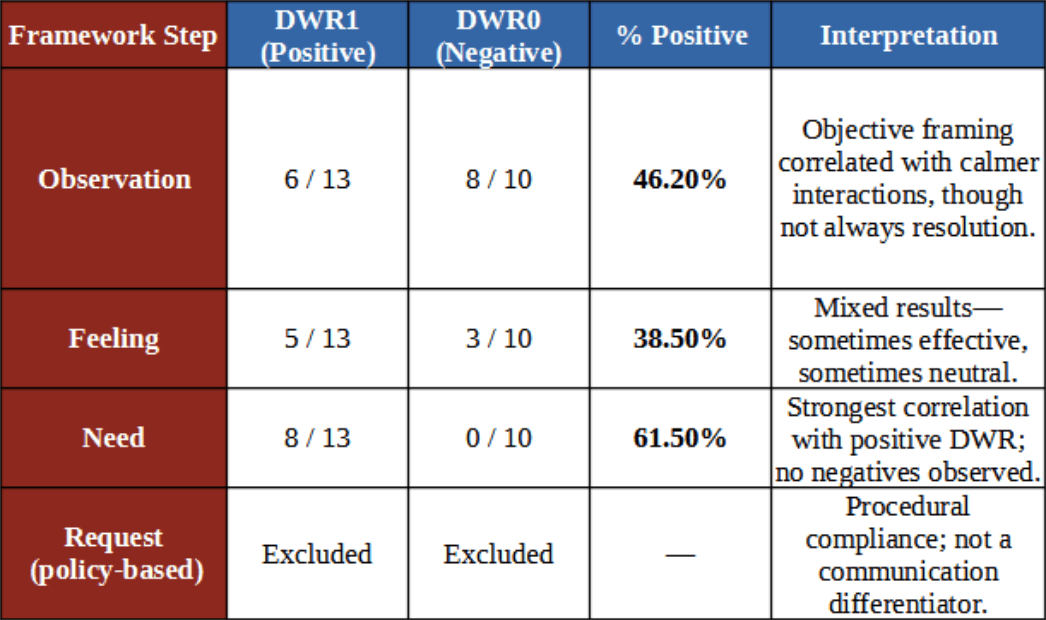
For this analysis, the Request step was excluded, as it largely reflects company policy or procedural compliance rather than the representative's communication behavior.
The Universal Language Framework (ULF)
The ULF, inspired by NVC but adapted for faster operational use, simplifies communication to two core steps:
- Strategic Observation (Fact Recognition)
- Need Identification (Human Motivation)
While NVC explores emotional expression through four steps, ULF focuses on the strategy-to-need connection, emphasizing efficient recognition of what matters most to the customer.
Data and Methodology
Each of the 49 Elite cases was manually coded to identify the presence or absence of Observation, Feeling, and Need expressions. Each case was also labeled according to its DWR outcome—positive (DWR1) or negative (DWR0). The goal was to determine which parts of the communication process best predicted positive DWR scores.
Findings and Interpretation
1. Need Recognition as the Primary Driver
Cases where customer needs—such as reassurance, reliability, comfort, or peace of mind—were identified achieved the highest correlation with positive outcomes (61.5% DWR1, 0% DWR0). When needs were recognized, even unsatisfied issues were perceived as "resolved," because the customer felt understood.
2. Feeling Recognition as Variable
Acknowledging emotions showed inconsistent impact, especially given the fact most company's support agents only verbally expressed two feelings: "angry" and "frustrated." For some customers, hearing "I can imagine how frustrating that must be" built trust; for others, it sounded scripted or irrelevant. This variability aligns with customer typologies similar to Chris Voss's negotiation model, and explains why feeling recognition did not consistently correlate with DWR improvement—it depends on customer type.
3. Observation Quality and Framing
Observation—the ability to describe facts objectively without blame—was moderately correlated with better outcomes but has potential long-term implications. Subjective or negative framing ("I understand this always happens with us") may still yield a positive DWR in the moment but could erode trust over time, potentially contributing to customer churn. Future retention-focused studies should explore whether observation quality predicts churn rates even when DWR remains positive.
Implications: NVC vs. ULF
By applying the NVC framework, the analysis inherently covered the core of the Universal Language Framework. Since ULF focuses on Observation → Need, and those steps showed the clearest link to success, this analysis indirectly validates ULF's practical efficiency.
- NVC: Expansive, deeply human, suitable for mediation and personal growth.
- ULF: Leaner, faster, operationally efficient—ideal for business environments requiring empathy at scale.
While NVC offers the full philosophical depth, ULF aligns better with real-time customer service, where time, policy, and customer expectations demand brevity and precision.
Limitations and Future Research
- Sample Size: The dataset of 49 cases limits statistical power; results indicate strong tendencies but not definitive conclusions.
- Short-Term Metric: DWR reflects immediate satisfaction, not long-term retention. Future research should correlate ULF/NVC communication patterns with account churn and repeat-order behavior.
- Observation Impact: Further study should isolate whether objective vs. emotionally charged observation phrasing affects trust over multiple interactions.
- Feelings Impact: A case analysis involving agents trained in broader emotional awareness would yield more reliable data on whether recognizing specific feelings significantly impacts current KPIs. Data from a company where agents only identify two emotions—"angry" and "frustrated"—is unlikely to serve as an ideal sample.
Conclusions
Empathy in customer service is not a fixed trait—it is a practiced behavior. This study shows that consistency of empathy depends not on emotional intensity but on the representative's ability to identify and articulate customer needs, which can potentially increase KPIs and Customer Satisfaction.
Citations
- Rosenberg, M. B. (2015). Nonviolent communication: A language of life (3rd ed.). PuddleDancer Press.
- Universal Language Framework, Maximiliano Torres. universalframework.online
- Cases with Abusive Customers interactions were excluded. Abusive Customers were defined as those who had a 25% or higher Credit and Refund request ratio.
- Chris Voss, A Guide to 3 Negotiator Types. blackswanltd.com